
Building a strong ‘engine room’ for digital fundraising
Jean O’Brien is a digital consultant and designer who specialises in non-profits. She founded the social enterprise Digital Charity Lab, which builds digital skills in charities. Jean is a Digital Associate with OKC and has worked with over 60 different non-profits as a consultant.
Digital for charities has always been fast-moving, and has always required constant learning and adjustment - they’re some of the things I love about it. It’s never boring. But the deluge of new challenges in recent years has been something else. Maybe a tiny bit of boredom wouldn’t be so bad after all?
Just a few of the challenges that digital fundraisers currently have to deal with:
Organic reach on social media continuing its relentless downward slide - we can now only expect to reach approx 3% of our followers on Facebook with organic posts, and other social channels aren’t much better.
The withdrawal of political ads from ad platforms in the EU. Meta has always lumped charity ads in with political ads, and now many charities are finding it difficult to run fundraising ads.
All kinds of other complications with ads too - such as restrictions on health charities tracking events on their websites.
Cutting through all the AI slop on digital platforms with our messaging.
Twitter (or ‘X’ if you’re the type of person who listens to Elon Musk) now being actively risky for our brands, due to the Grok AI-generated images scandal.
‘Enshittification’ - the general degradation of digital platforms as they attempt to squeeze more revenue out of their users.
The only way to handle this constant shifting and changing, is to focus on the fundamentals, and to make sure your organisation has a solid digital ‘engine room’ - the infrastructure that ensures you’re both growing and sustaining your warm audiences on digital channels.
What’s needed in a digital engine room?
So what does a good digital engine room look like now, in our chaotic year of 2026? There’s four fundamentals to get in place:
Tracking and measurement
Digital ads
Email marketing
Website journeys
I’ll break each of these down and give you some recommended actions to take this year. And don’t worry if it sounds a bit daunting - many of the actions are standalone projects that you only need to set up once, and quite a few of them dovetail together.
Tracking and measurement
Tracking is fundamental - if we don’t know which of our digital activities are bringing in the best return, we’re effectively stumbling around in the dark. But tracking in the charity sector seems to have gone backwards in recent years.
Google holds some of the blame for this: they shut down their long-running ‘Universal Analytics’ measurement tool in 2023 and forced a move to Google Analytics 4. A lot of charities didn’t have the internal expertise to configure Google Analytics 4 properly, and are now barely using it at all.
It can also be difficult sometimes to know what to track, as the digital channels all return so many metrics and data points. I still see a lot of charities tracking follower numbers on social media for example, despite that being long established as a vanity metric.
I use the following framework for digital reporting - it’s both straightforward and results-focused:
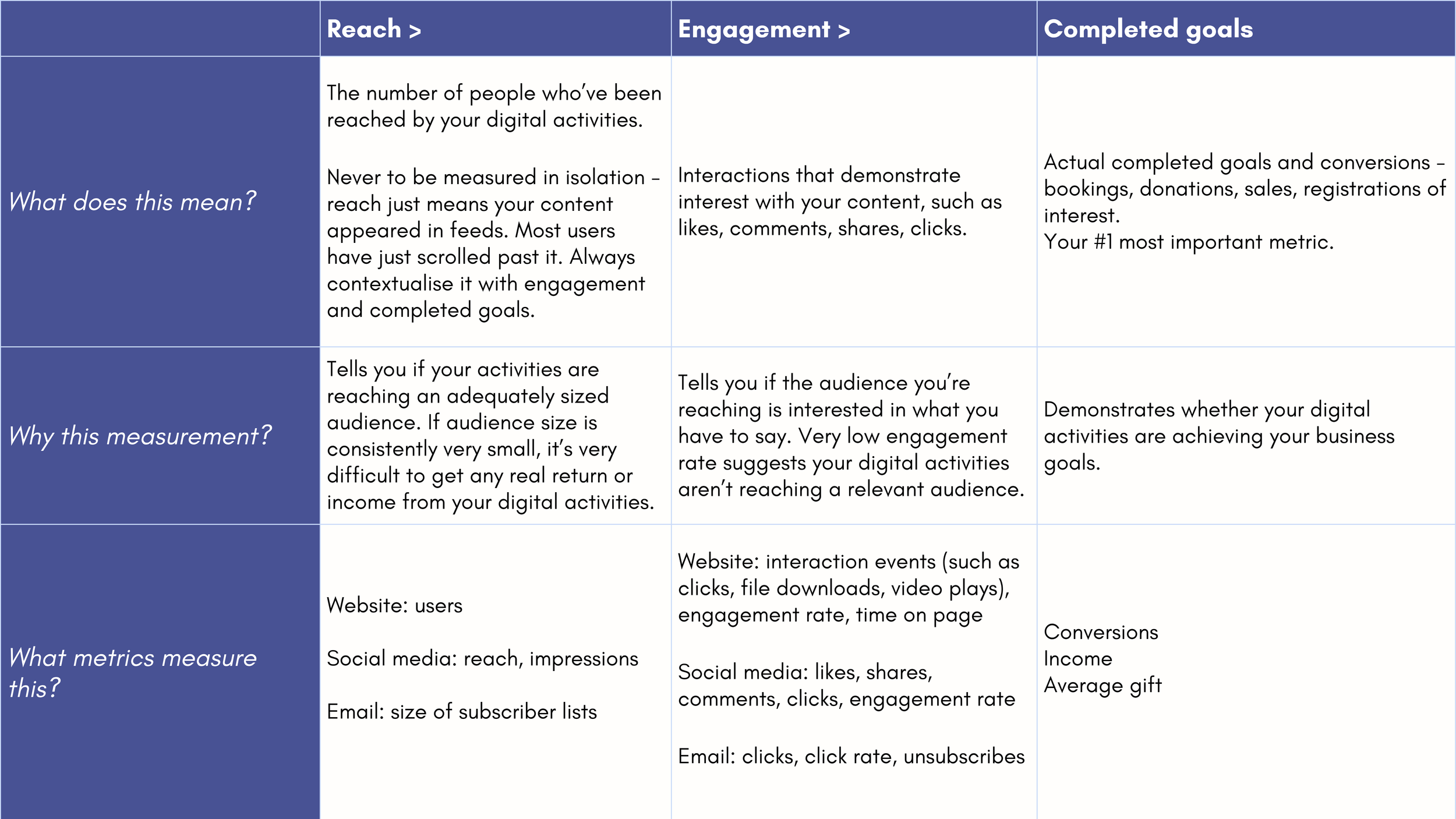
More about how to measure your digital campaigns, and why ‘reach’ is not the same as ‘awareness’, on Digital Charity Lab.
Recommended actions for your tracking and measurement:
Get your Google Analytics audited and check that all your conversions are tracking properly.
Review your current reporting framework if necessary, update it to focus on meaningful over vanity metrics.
Digital ads
A paid strategy is a must-have nowadays - very few causes are getting a strong, consistent return on organic social. The social platforms were all set up to eventually sell ads, and this excellent article from Brian Balfour explains in detail how platforms all go through the same process: open, close, monetise.
The two best ad channels for charities with limited time and budget (and for big charities too) are: Meta and Google.
Meta Ads are still delivering, despite myriad challenges with ad approvals, AI slop, competition, and tracking. I’m still seeing good conversion rates from Meta lead generation ads to donors all the time - such as an 8% conversion rate to donors on email lead ads for the Catherine Connolly for President Campaign in 2025.
Lead ads are your best bet with Meta - capture people’s details in the Meta lead form, put them on an email journey and ask for their support there.
Lead ads will give you excellent value if you can run them over a long time. If your ad spend is currently clustered in annual campaigns, review where you can move budget into ‘always on acquisition’ instead. This will mean that you can constantly replenish your mailing list and database, at an affordable daily budget, requiring minimal time to manage.
Google Ads get better all the time - their Performance Max format is very powerful. I’m seeing great results with Google Ads for even niche and high-value audiences - such as a cost per acquisition of €20 for donors to a community fundraising campaign in 2025, including schools and corporates.
Google Ads are slower to learn than Meta - they’re great for ‘always-on’ campaigns too; much less effective for anything short term.
Google Grant Ads are good for top of funnel informational searches, but they struggle to compete with paid ads for the higher value conversions. The best option is to use both Grant and paid Google Ads if possible - use your Grant account to target the low-competition keywords, and the paid ads for your fundraising campaigns.
Recommended actions for your digital ads:
Review your digital ad strategy - prioritise ‘always on’ lead generation and donation campaigns
Diversify your ad spend between Meta and Google
Email marketing
Does email still matter in this age of social and AI? Rhetorical question; of course it does! Email has always been the most solid and reliable digital performer. It gets declared dead roughly every two years, but people still open their emails and they still sign up for lists.
Email is great for cultivation, building relationships, and driving conversions.
And a lot of charities are still sending very outdated or infrequent emails, so if you do it well, you’ll get a competitive advantage too.
Recommended actions for your email programme:
Prioritise email acquisition campaigns in your paid digital strategy and grow your lists.
Make use of automated journeys - they’re quick and easy to set up, and highly effective. If your new subscribers and prospects get something from you right away, they’re highly likely to engage with it and take action.
Set up automations for niche and high value prospects too, like legacies and corporate sponsors. Use a light touch automation to support the personal contact - as we all know, the personal relationship is more important than ever.
Review your email approach and make sure it’s friendly and personal, not corporate. Email is a direct, personal medium, and we’re missing a trick if we’re not making it feel warm and human.
Website journeys
Websites also still matter, no matter what over-eager AI salespeople might say. Your website is still the central hub for your online presence and the place where your prospects will go to learn what you’re about. Be skeptical of anyone telling you to burn down your SEO in favour of AI search - this LinkedIn post from SEO expert Nikki Pilkington shares an entertaining horror story about ‘AI search optimisation’.
Look at the user journeys on your website for each of your priority fundraising audiences - individual givers, corporate sponsors, grants and foundations, legacy prospects:
Does each page serve as an attractive, convincing ‘one stop shop’ that gives them all the information they need?
Has it provided multiple contact options - as not everyone will want to call you on the phone?
If there’s a form on the page, does it redirect to an attractive confirmation page with a warm thank you?
Even if your website is clunky to update and you have limited templates, you can at the very least polish up your key landing pages and ensure that they feature attractive text and imagery.
Recommended actions for your website journeys:
Review and improve user journeys for key audiences.
Set up bespoke confirmation pages for each online goal.
Get conversion / key event tracking set up on Google Analytics for each page with a fundraising goal.
Sorting out all of the above will ensure your digital fundamentals are strong and you can weather changes. Meta introduces some sudden, horrible change, as they tend to do? Move budget to your Google Ads programme. Organic social isn’t working for a campaign? Use your enhanced tracking to establish which channels are getting the best engagements and results, and ramp up efforts there instead.
It’s all very doable, and it’ll pay off in both fundraising income and peace of mind in the turbulent years to come.
—
OKC and our Digital Associate Jean O’Brien are here to support your digital fundraising journey. From incorporating digital into your fundraising strategy, to developing digital acquisition campaigns, to online journeys for high value prospects - we work with charities and not-for-profits to ensure your efforts deliver long-term philanthropic impact. Contact us today to book an introductory call.